

RAINWATER (2026)
In the sweeping landscapes of the American West, where open plains stretch far beyond the horizon and history is written into the earth itself, Rainwater emerges as a powerful and emotionally charged drama about land, identity, and the enduring strength of Indigenous communities. Anchored by commanding performances and a story rooted in cultural resilience, the film explores what it truly means to defend heritage in a world driven by political power and economic ambition.
At the center of the story is a respected tribal chairman portrayed by Gil Birmingham. Known for his quiet authority and deep moral conviction, his character becomes the leading voice in a growing conflict when a massive energy corporation proposes a project that would cut directly through sacred tribal land. What initially appears to be a promise of economic development soon reveals deeper consequences, threatening the community’s water, environment, and centuries-old spiritual connection to the land.
The film portrays leadership not as a position of privilege but as a heavy responsibility. As chairman, he must navigate negotiations with powerful political figures while also answering to his own people, many of whom fear the irreversible damage the project could bring. Every decision carries the weight of history and the expectations of future generations.
Standing beside him is a rancher portrayed by Mo Brings Plenty, a man whose life has always been tied to the rhythms of the land. His character represents the everyday connection between people and place. Through him, the film emphasizes how culture and tradition are not abstract ideas but living practices that shape identity, community, and belonging. His loyalty to the land becomes one of the story’s most emotional anchors.
Adding another layer to the narrative is the return of a strategic thinker played by Zahn McClarnon. Having spent years navigating political systems far from home, he brings with him a sharp understanding of how influence, money, and power operate behind closed doors. His presence introduces a new perspective to the community’s struggle—one that recognizes the importance of strategy as much as conviction. Through his character, the film explores the delicate balance between honoring tradition and adapting to the realities of modern power structures.
Guiding them all is a wise elder portrayed by Tantoo Cardinal. Her presence in the film serves as a spiritual compass for the community. She reminds the younger leaders that their fight is not simply about politics, legal rights, or economic interests. It is about protecting a way of life that has endured for generations. Her words carry the wisdom of history, reinforcing the idea that land is more than property—it is memory, culture, and identity.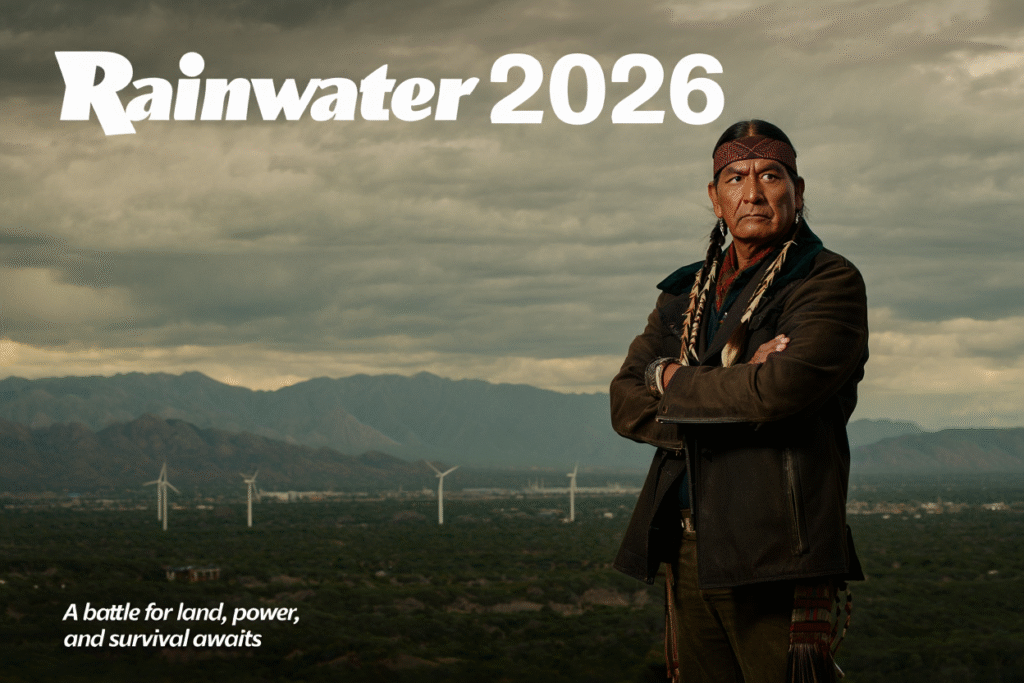
What makes Rainwater particularly compelling is its focus on collective struggle rather than individual heroism. The film portrays the tribal community as a living network of voices, perspectives, and responsibilities. Internal disagreements emerge, alliances shift, and difficult compromises must be considered. Yet through these challenges, the story continually returns to a central truth: the bond between people and their land cannot easily be broken.
Visually, the film uses the vast natural beauty of the Western plains to underline what is at stake. Rolling grasslands, wide rivers, and endless skies become more than scenery—they represent the living heritage the community is fighting to protect. Each landscape shot reinforces the emotional gravity of the conflict.
Ultimately, Rainwater is a story about sovereignty, resilience, and the enduring fight to protect cultural identity in a rapidly changing world. By weaving personal struggles with larger political forces, the film delivers a powerful reminder that the defense of heritage is not just a battle for land, but a fight for the future of an entire people.